Projects
15 examples are shown below. There are a lot more projects existent.
Sramadanas -
What is actually sramadana ?
Rural Villagers get together for a day and put their own manual labor for infrastructural or other changes in the community. Together they cut new roadsides, clean the school grounds, make a waste disposal pit and so on. Farmers also work collectively on each others lands without being paid. The PALM 2 strongly promotes this program because unity and ownership among the villagers increases.
Organic Farming
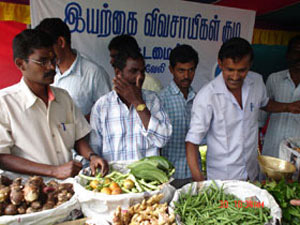 Years of utilization of chemicals have resulted in a severe acidity of most soils, and the cultivation of good vegetables has become difficult. This resulted in severe crop losses without the ignorant rural farmer realizing why. More than 30 farmers groups ( appr. 450 farmers ) have continuously been made aware of this problem by the agriculturist. 35 farmers have now devoted themselves to a pure and non chemical farming after a transition period of 3 years. This is actually the traditional way of farming. They have learned how to enrich their soil using locally available resources , how to develop a crop calendar, what is mixed cropping and how to apply crop rotation to maximize the outcome in the field. The farmers also have learned to make their own bio pesticide and bio compost. The vegetables not always look the same as when chemical fertilizers are used, but once a customer is used to the taste of organic vegetables, he will never change back to the artificial looking and watery tasting chemically fed vegetable. A further 30 farmers are now in the transition period and they will be linked up to the organic network soon. The demand for organically grown vegetables is increasing in the nearby cities. It is the need of the hour to produce and process own organic manure on a large scale ( see under projects : Composting and Bio gas ) The farmers are registered under a separate Farmers Association called : Community based farmers Organisation CBOF and are now looking into the possibilities of organic certification of their lands together with PALM2.
Promotion of animal
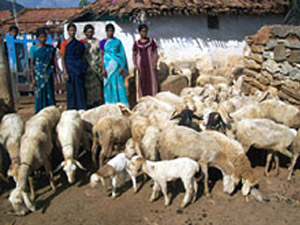 More than 1000 small farmers/ group members of PALM 2 are in some way involved in the rearing of one or more cows and goat rearing. Specialised training by our qualified staff for the members have resulted in better milk production, identification of diseases, healthier animals and less deaths. Parasites in the intestines in cows are very common, the cow will become very anaemic and premature delivery is regularly occurring. Taking out an Insurance for cows and goats has helped to prevent financial disaster for the family.
The farmers have followed extensive trainings about nutritious fodder production called Azolla, which has proved to increase the milk production by 1/3. The PALM 2 staff is also trained in high tech commercial dairying and are motivated to closely monitor the farmer’s progress in the field.
Milk is either sold locally or collected by the chilling centers available in the nearby towns.
A family of 4 can live from selling 20 liters of milk per day.
Promotion of bio gas
In total organic farming the cycle includes rearing of 1 or 2 cows to produce urine and cowdung for the process. Recycling of all the stable waste into bio gas, keeps the premises clean and promotes a balanced eco system by avoiding the emission of methane gas in the air. A series of organic manures are also being produced from the waste. Even in places where no electricity has been supplied, the group members of PALM 2 have shown great interest in constructing bio gas units. With the dung of 2 cows a farmer can produce power to light 2 bulbs of 60 Watts. Thus making it possible for the children to study and do their home work in the evenings. The gas is also utilized for cooking purposes. The Government of India is assisting in the construction of the bio gas units with a subsidy of 35 % , being utilized by PALM 2. Two staffmembers have been trained in the technical background, the doom type units are constructed from ferro cement. So far three units have been completed in rural villages.
Production of bio compost
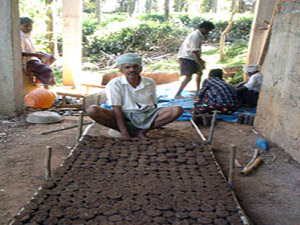
Natural resources are being promoted to improve the soil conditions and to sustain the crop production. Big quantities of organic materials are not always available and need to come from outside the target area.
The farmers CBO in Devarshola has undertaken the production of massive quantities of organic manure with our guidance. Big quantities of waste of a nearby sugarcane factory will be used for this purpose.
A piece of land from one groupmember/farmer was identified for this project in which 9 farmers will actively participate. In 2008 the PALM 2 assisted the Devarshola Panchayat with technical know how on the setting up of a compost unit out of the street waste of the town. This project is profit making and a sample to the newly proposed activity .
The raw materials will be processed into compost, packed in 10 - 50 kg bags and sold for a profit.
1 kg. will be sold for 3.5 rupees which is 1 rupee cheaper than the market price.
Promoting chicken
I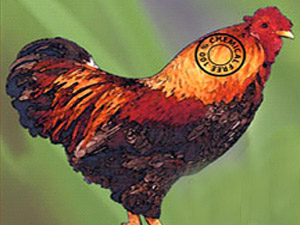 n February 2009 the PALM 2 motivated 15 farmers to commence the rearing of country broilers in numbers between 25 and 100 . Some initial problems had to be overcome such as : allocating the right varieties of baby chicks, choice of non chemical economical feeds, supplementary feeds from own surroundings, need for timely vaccinations, and keeping proper hygiene in the locally made sheds.
The woman entrepreneur from the plantation areas is able to earn an additional 1000 rupees per month, if the appropriate recommendations are followed.
The chickens are being sold locally and via the newly established marketing committee in PALM 2.
Seeing the success of the practicing farmers , many more group members are now eager to start the same project. Processing and selling the broilers in time will enhance good profits and a training in hygienic butchering and packing will add value to the product in the future. The product will be ideal for food shops and supermarkets !
Inland
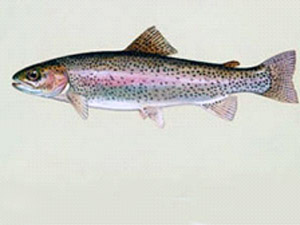 Certain water storages, water tanks of a good size can be utilized to grow sweet water fishes of different types such as carps, tilapia, etc. The poor landowner is eager to dig a pond of 30 – 30 meters for this income generating purpose. Fingerlings can be purchased from the Department. After a period of 6 – 9 months the fishes have reached maturity, some having a weight of 2 kgs. They can be sold for 70 rupees per kg.
Under the department of Inland Fisheries this project is being recommended and for 90 % subsidized. A proposal for 60 farmers has been submitted to the Department and the approval is being awaited for more than one year.
Financial support could hasten the process and ultimately the income of the poor farmer.
Ornamental fish
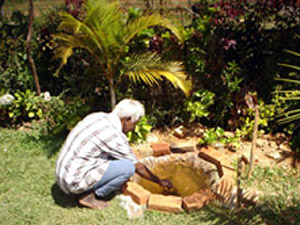 15 women group members without an income and with limited land holdings, showed interest in ornamental fish culture and the PALM 2 agriculturist has linked up the farmers with the Fisheries Department to be trained in economic cultivation of ornamental fish. The project does not need much supervision and little space. It can be implemented as a supplementary project for each entrepreneur, which can lead to good sales. The PALM 2 staff is trained in close follow up and monitoring the project. An investment is being sought for a retail outlet in a central place, where marketing is freely accessible .
Mushroom cultivation
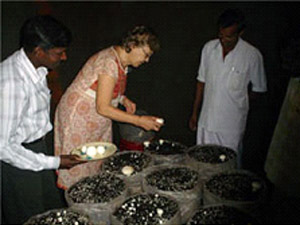 Mushroom cultivation requires limited space , hygienic conditions and a dark room. Different altitudes in the Nilgiris state allow different types of mushrooms to grow. An experiment was done by the PALM 2 agriculturist early 2009 with button mushrooms at 1000 meter altitude. The project is potential to expand on a commercial scale in the near future. Oyster mushrooms were tried by several poor people who have no access to space in special trial units, the grower is able to fetch 100 rupees per kg. and the product is rather popular among the vegetarians. Group members have been trained in the production of quality spawns to prevent poor quality seeds from outside and to reduce the production costs. Financial help is needed for a simple micro laboratory for quality production of mushroom seeds. This will assure continuous supply and as such a supplementary income for the grower. By using own lab facilities the chances of contamination are also eliminated .
Bakery unit
There is a growing demand for bread by the day laborers and plantation workers, as making chapattis in the early morning is very time consuming.
25 women and men from O’Valley were trained in the end of 2008 to learn how to produce bread and different bakery items, such as biscuits, cakes and other local savories.. 12 Women of the trained participants have been eager to commence a bakery to gain an income for their families. A suitable bakery was identified on the main road in the rural area itself and all preparations such as working schedules, tasks , marketing of the items have been designed by the women. A detailed budget was submitted to the State Bank of India for a loan. The Government approved a
35 % subsidy for the project. The poor women are still waiting for approval of the loan!
Commercial tailoring unit
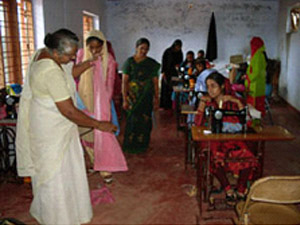 Despite the global recession, the local demand for well tailored clothing is on the increase. This was shared by several factories in Tiripur ,who supply internationally and on the Indian market.
25 Women tailors of Devarshola had learned the basics of tailoring and it is those 25 highly interested women who are now being trained by PALM 2 in professional tailoring . The women are members of the CBO Baratham, who is in charge of the project.
The training will take one month and if needed additional courses will be offered, not to leave the women half trained. Orders from big factories will be taken in high quantities and the women have already worked out a time schedule of work, the means of transport of the goods etc.. A proposal and budget was made with the help of the PALM 2 trainers and submitted to the local Bank for support and to the KVIC, who will extend a 35 % subsidy to the project.
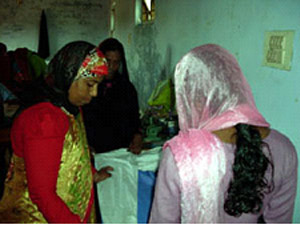
The electrical high power sewing machines with all facilities such as overlock and backlock will cost appr. 60.000 rupees . Urgent assistance is needed for this project , as 5 of such expensive sewing machines will have to be purchased to promote a regular income for the poor housewives.
All women are deserving housewives in need of a supplementary income , They cannot leave their husband and children to attend outside training courses, as such they are happy to be able to develop their talent within the village itself.
Banana and tapioca chips
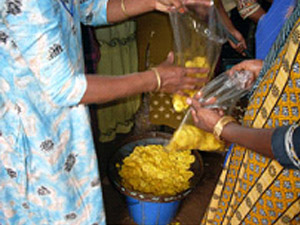
A banana is a seasonal fruit and during the high production time , the market price goes down drastically. The farmer is unable to meet the cost of production during that time.
Value addition could ensure a better support price to the farmer .
25 women group members have been trained and 12 women are processing banana and tapioca, by deep frying small slices of the product, packing it and market it through the marketing committee. The small entrepreneur is able to sell the product for 80 rupees per kg which needs basically appr. 3 kgs of raw banana.
A small pick up or a load auto rickshaw would make the transport of the raw materials and finished items much more efficient.
Minor Forest produce
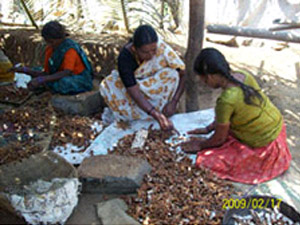
The tribal communities in the Thalavadi target area have been living from the forest products for ages. They collect amla, tamarind, broom grass, medicinal tubers, gums, fibres and tree seeds and sell it through a distribution network of private middlemen. The Forest Department started to intervene in 2006 and commenced a new scheme where the tribal people are trained in value addition of the product. Village Forest Committees were established by the Forestry Department and for practical implementation handed over to the NGOs . The PALM 2 was assigned to 5 such VFCs . The SelfHelp concept is being emphasized among the tribal women and several small scale income generating activities and available loan subsidies are being linked up at present. Financial support is requested by PALM 2 for additional infrastructure development for the processing of amla, tamarind and honey and the related training programs .
Cottage Industry for plantation women
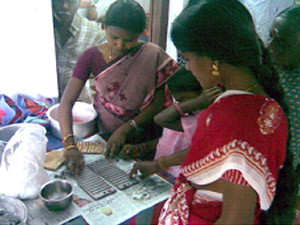 30 housewives from O’Valley without an idea for an supplementary income have approached PALM 2 to allocate a suitable small scale income generating activity. The husbands as well are not assured of daily work and do not earn more than 1500 rupees per month maximum.
Based on their requirements, the PALM 2 has organized a training program in producing different types of small scale articles such as : chalk pieces, candles, incense sticks, all types of soap items, phenol ( a floor cleaning liquid ) and a basic idea in screen printing.
The basic materials need to be collected from bigger cities and needs to be purchased in bulk.
The women are highly enthusiastic in this new enterprise. A training in entrepreneurship has successfully been given to all the women to prepare them for marketing. The PALM 2 feels that funds for initial materials could ease the burden of the labor such as a variety of molds, dyes, and the stock of raw materials should be build up .
Due to the popularity of the program a second training program is planned for the Thalavadi target groups.
Palm plates production
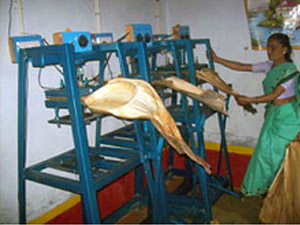
Irregular incomes from the tea plantation Manju Sree, have urged the women group members to look for alternatives. Since the aricanut palm tree is freely available on at least 850 acres on private plantations in and around Gudalur, a project to process the unutilized leaves was proposed . The large leaf sheath, covering the stem of the tree is ideal for making disposable plates, cups and tumblers and is not utilized by the landowners.
Marketing the product proved potential as the use of plastic plates is being banned more and more.
One CBO named : Malaiarasi has identified some group members who are keen to explore the production possibilities. An exposure trip was made to a successful producer in Thalavadi.
Money is now being sought for the purchase of hydraulic power press machines of different sizes to get the producers on their way.