About Palm2
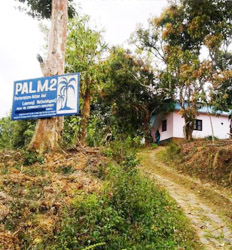
Palm2 has its main office in Gudalur, the Nilgiris District in Tamil Nadu, and a field office in Thalavadi in the Erode District in South India . We work with approx. 12.000 families. PALM 2 works in two main target areas: The Nilgiris commonly termed as “Blue Mountains" of Eastern and Western Ghats are said to be the highest mountain ranges of South India. The whole of Nilgiris, eleven degrees north of the equator, forms an elevated steep upland from the low lands of Tamil Nadu in the east, Karnataka in the north and Kerala in the west. Our target area Gudalur is located close to the borders of the three states. (See map) The main crops in this area are tea, coffee, spices grown on large plantations, belonging to multinational companies. The small and marginal farmer, who grows vegetables, bananas, spices, tapioca and other mixed crops, is living around in small villages around the plantations. The tribals live in small hamlets isolated from other communities. Thalavadi in the Erode district is our second target area. This district borders the state of Karnataka. It is an isolated hill country with many wild animals, mostly elephants. This is a less humid area with healthy soils for cultivation. The tribal villages are splattered between the farmer´s communities. The remote villages are difficult to approach by public transport. The poor, low caste people live on one site of the village and are not allowed to use the same water source or drinking cups as the high castes.
History of PALM 2
When a Dutch development worker came to India to educate her 2 adopted sons in Ooty, the Nilgiris, she had already a long history of involvement in community development projects in Africa and in Sri Lanka among the Tamil plantation workers. With a background in nursing, the programs usually started with preventive health education but soon expanded into connected areas such as social awareness and infrastructural needs and changes. Thousands of toilets were built by PALM 1, using peoples committees , numerous water supply schemes and 15 hospitals, medical centers and schools. All programs were implemented through the people themselves.
Mandates and directions in development have changed since the eighties and more than infrastructural changes emphasis is now put on peoples own capacity and resources.
While PALM 1 is still growing in the hills and on the east coast of Sri Lanka , PALM 2 started to take shape in 2002 in the Nilgiris initially on request of the plantation workers. A large percentage belongs to the SriLankan repatriates, who had to return in the 70th and 80th after an agreement was signed between the two governments.
Since no social structure can be isolated in development, adjoining villages became part and parcel of the program soon in the Gudalur Block, initially in O’Valley. The geographic area is known for its outstanding land issues and no farmer has been able to get ownership of his land.